Friday, July 29, 2011

Is the "Debt Crisis" a "Crisis"?

Here is some data I put together based on the debt to GDP ratio for my Intro Sociology class, when I introduce the idea of "social panics" (the Salem Witch trials are a great example--we have a "panic" about every decade).


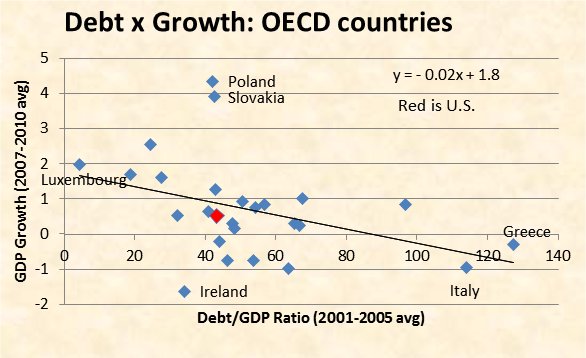
1) We look pretty much like all of the other OECD countries, whether you're talking about growth, or the debt to GDP ratio. Chart 1 is a plot of growth vs. debt/GDP of the OECD (high income, industrialized) countries. The red dot is the U.S.


2) We've been here before, in the 50s, and our economy was doing just fine. (Chart 2)


3) Has there been some radical change in how much we are paying in taxes? Yes--since WWII there has only been one brief period when our tax revenue was as low as what we are paying today relative to our GDP--by far. (Chart 3)


First Public Campaign Speech

I gave my first public speech today. I gave one to a small group of supporters last month, but this was a "street speech" at a protest of the proposed cuts to safety net programs, contrasted with the continued failure to address the fact that many large corporations are finding ways to pay no taxes (usuncut.org). Here is a copy of the speech:

While Congress has been debating budget policy, transnational corporations and plutocrats are winning. Conservatives assume that every person is a self-sufficient island, each of whom starts life on a level playing field with everybody else, therefore in the game of economics, everybody is entitled to keep all that they win. However, they forget that we are all born into differently endowed families, and our life chances are tied to those resources (or lack thereof). The vast majority of poor remain poor, and the rich get richer, while our rates of poverty and social inequality in the United States are greater than in any other industrialized country and reached crisis levels decades ago.

Conservatives assume that safety net programs increase poverty by incentivizing laziness and slow economic growth by draining resources from productive workers, thus taxes are better left in the hands of mega-businesses and the new U.S. aristocracy. However, most people want to work if jobs are available, but when full unemployment and underemployment is at least 17% in Indiana, and a 40-hr week at minimum wage provides poverty line wages ($15k), the assumption of viable work is faulty. The average rate of child poverty in the U.S is 21%, while the combined rate in the rest of the industrialized world is 10%. Cutting safety net programs only creates impoverished families, while those countries that invest in social goods (healthcare, education, jobs retraining, family assistance), tend to rank highest in health, democracy, and economic growth.

Finally, conservatives assume that taxing the wealthy punishes success, which sounds plausible, given that the top 50% of earners pay 93% of U.S. income tax. However, those same earners monopolize 90% of income, while the bottom 40% of families in the United States have an average net wealth of $0. Further, real income for the bottom 60% of workers has stagnated since Nixon, while the income of the top 5% has doubled. Thirty years of the neoliberal experiment has not produced a stronger society. Rather, it has eviscerated the social contract on which our country’s vision was founded. The larger question is whether it reasonable continue supporting a system where half of our citizens have insecure food and housing, while transnational corporations outsource our jobs, disregard the safety and welfare of their employees, and have widely publicized records evading all taxes?

Thursday, July 28, 2011

Debt Ceiling Shenanigans

As with most of the rest of the country, I've been enthralled with the soap opera drama of Congress: will they or won't they? As the August 2nd deadline grew closer and no plan seemed to appear, I grew more skeptical that they would reach a compromise. I even spent 2 days collecting and analyzing demographic data about the current House of Representatives, especially Tea Party endorsed representatives, who have been holding up the process.

Then tonight I realized that the Democrats only need 25 Republicans to vote for the debt ceiling increase. Normally they would need 218 votes, but with vacancies and illness, they need either 216 or 217. One of those ill is a Democrat, so they have 192, which means that if they all support raising the debt ceiling, then there only has to be a few Republicans who prefer not to cause a collapse in our global economic trust when the first of our bills start to go unpaid. None of the tax reform/spending cuts/hula hooping even needs to get attached, and the congress will again have wasted months creating fun political theater for the voters back home and 24-hr news corporations.

The cynical may argue that those Republicans will face losing their seats during the next election, since the Tea Party has promised to run challengers to any defectors. However, as a sociologist who has studied social movements for years, whenever there is a movement there is a counter-movement. This is especially the case when the first movement is loud and threatening. Take the Tea Party--it is a counter-movement to Obama's success. The Tea Party has brought the country to what is perceived by most to be the brink of economic catastrophe, piled on top of the mess perceived to have been left by Bush, not to mention the fact that this class of freshman TPers was elected in year when only 1/3 of us bothered to show up at the polls. Which means this: Tea Party challengers will pose no danger to Republicans who vote for the debt ceiling to be raised. Moreover, the challenge for the Tea Party is to not get booed off every stage in the next election. All they have done is handed Democrats control of the House in the next election, and assured Obama that he can take it easy next year (provided of course that unemployment doesn't spike next October). At this point it doesn't matter which side is ideologically right or wrong, since public perception has consolidated to the belief that the Tea Party is the source of this logjam, and when it comes to politics, perception is all that matters to agitated voters.

Tuesday, July 19, 2011

Officially a Candidate

A trip to the city-county building today confirmed that I'm officially a candidate with 183 signatures. All of the legwork with hot, sweaty days knocking on doors paid off. Not only meeting people and hearing their concerns and thoughts, but with a candidacy confirmation.

The next step, the campaign, sounds equally as challenging, since none of this is remotely familiar, despite having read numerous books and studies about social movements and political sociology.

Since it is feeling more real, I checked out a book from the public library, "Mayor of Castro Street," by Randy Shilts. He tells the story of Harvey Milk, who won a seat on the San Francisco Board of Supervisors. I thought the biography would give me insight not only into city politics, but being an out, gay city politician.

I soon hope to arrange a meeting with my two competitors to get a sense of what the next 4 months has in store, and ideally, arrange a public debate between us, so the public can get a sense of who we are, what we think is important, and how we might differ in our approaches to city politics.

Thursday, July 7, 2011

Still Pending--No Word Yet

It's been a week since my frantic last-minute signature-gathering effort and I'm still in "pending" status. I called today to see if there was an update and there is none. The voter registration office has some internally conflicting information, and the person who actually makes the decision to certify me is out of the office until next week. They have me on record for more than my required signatures, but the process hasn't been made official for some reason, and the office can't tell me why. I also was told that any of the people I registered to vote, who also signed my petition, cannot be added to the valid petition signatures if their voter registration was not verified prior to the certification deadline.

Friday, July 1, 2011

Frantic Canvass

Several days after what I assumed was my final canvass, I called to confirm that I had plenty of signatures. The previous week I was confirmed at 148, so over the weekend I went out by myself in a neighborhood adjacent to mine, and collected almost 30, and was expecting around 15 from a woman who had volunteered to canvass in Broad Ripple. Combined, even if the city continued to kick out signatures at a rate of 40%, that would still put me over my minimum signatures. Signatures had to be turned in at 12:00PM on Thursday, so when I called at 10AM, I was told I still only had 148, and 20 of those were still "pending" (voters I registered, whose identities still needed confirmed)!!! The first few workers I talked to did not have a record of the 30 I turned in on Monday, nor the other volunteer, whom I had been unable to reach for over a week. I was advised to run out and get as many signatures I could in the hour that remained and get them in the office by the deadline. I was able to get 4.

Fortunately, the other signature sheets were found, and by 1PM I was told I was over my minimum signatures, as long as the voter registration "pendings" were confirmed. I won't know for certain if I'm officially on the ballot for perhaps 2 weeks, when I'll received a letter telling me that I had the minimum signatures to be certified as a candidate.

Now I have to find a "committee" and a "treasurer." I put these positions in quotes, since I have no idea what they are or where I might begin to find them. All these forms and deadlines... I have never been good at administrative tedium, being far better at research and analysis. For example, I recently completed an economy simulator for my students, that incorporates OECD data for the last 20 years, comparing government policy (taxes, spending, etc) on various outcome measures, like health, violence, and economic growth.
Economic Policy Simulator

Monday, June 20, 2011

Canvassing (Part II) and Stumping

We thought we were close to being done with the canvas to get a 2nd candidate on the ballot for my district, so we could actually have democracy in my neighborhood. The election board has been incredibly helpful in keeping us informed about what they are accepting and what they aren't. Unfortunately, of the 180-ish signatures we collected, they are only accepting 111, meaning about 40% of the community we tried to include into the political process, have been disenfranchised. Granted some of those citizens should legitimately have been excluded, since they are outside of my district. But our estimate was that accounted for less than 10% of our signatures after we went back to our district map to check the addresses.

Today I started again in my area. My helpers from last week gave all they were able, and I can't believe how much help I had. The total work was about 50 hours, coming up to about 2 valid signatures per hour. Hopefully I had better luck today, since the income levels in the neighborhood I canvassed today is greater than Hovey, Ralston, Caroline and Guilford streets from last week. It's a shame when I can feel safe in assuming greater political voice of a citizen based solely on income level. Then again, data indicates this is the case, when the median net worth of a US citizen is $95k, for a US house representative it is $800k, and the median net worth of a U.S. senator is $1.7M (2008).

I don't get them often, but I occasionally run into the cautious person who won't sign because they want to "investigate who I am" first. I've been trying to decide if they really believe this line, since certainly they won't do any "investigation," or if they believe it's a polite way to say "no thanks." It's certainly any person's human right not to sign a document that grants them voting rights, and given our 35% voter turnout, that sentiment seems to be normative for our culture. I suppose I shouldn't complain since I was a voting protester for 20 years, but in this case it seems like a very different kind of decision. In my case, I consciously decided that I could foster democracy and humanitarianism in ways that did not lend support to power-politics. In the case of these folks who are refusing to sign the petition, they either like the current candidate and don't want him to have competition, or they don't want to be bothered and I suppose they are too polite to just tell me to go away. I have had several of the "get off my property"-type folks, who I have grown to respect more than these other types of citizens.

Yesterday I gave my first public "stump speech" to a small group, which won me my first political endorsement. Here is the speech that I read:

"Government and business are fundamentally different social structures. Especially in the United States where our laws and culture have developed to prioritize the individual consolidation of wealth, even when it harms the public good. This unification of culture and legislation has ramped up since the 1980s, such that both Republicans and Democrats have succumbed to the mythology of neoliberalism, that low taxes on the wealthy will allow them to invest in business, and cutting benefits for the poor will encourage them to go work. But neoliberalism ignores fundamental patterns of human behavior. First, humans derive fulfillment from work. Both Democrats and Republicans seem to assume that the poor are inherently lazy and inclined to criminal behavior, and that the wealthy are inherently inclined to invest in employment. However, 30 years of data, beginning with the 1980s, confirms that the wealthy tend to hoard wealth, and the poor will work if jobs are available. The tragedy is that the number of jobs has been plummeting, since corporations are more willing to send those jobs overseas where workers are little more than slaves and are far cheaper than U.S. workers. Similarly, corporations, rather than investing in the common good, invest primarily in projects that benefit their board and their investors, even if it means dangerous working conditions for miners or oil riggers, or dangerous products for U.S. consumers. Rather than increasing funding and transparency for public safety, neoliberals in both parties prefer to strip this function of government, assuming falsely that corporations are inherently incentivized to maximize worker, consumer and public good, when in fact, the record shows they are incentivized only to maximize profit at any cost.

What the record shows us, whether Reagan, the Bushes, Clinton, or Obama, is that government does not need to be stripped of power as such, but the government needs to be returned to a social structure that is by and for the people, one that protects public safety, worker compensation, and the re-enfranchisement of the poor. This can only occur with an educated, empowered population who have the capacity to affect public policy. Locally, both Democrats and Republicans have been voting to sell public goods to private entities, and to disenfranchise women, racial minorities, sexual minorities and the poor. Our response to this must be to empower third party candidates and remember , when voting, that the wealthy and corporations already have far more power than they need, both of which have been consistently empowered by the current two-party system, while stripping the poor and middle class of political voice."
Saturday, June 18, 2011

Canvassing Day 5

Today took a warm turn--it started to get hot, and made canvassing difficult. The street we were on seemed like a nice, quiet street, although still poor and with a lot of empty houses. However, residents said it was simply an unusual day, since normally the warm weather brings loud neighbors out of their homes to hang out on street corners.

What was supposed to be the last day of canvassing, a thought that helped me get through the hot afternoon, turned out to be far more demoralizing. The city-county workers have been very helpful so far. However, today they had to inform me that they are throwing out over 1/3 of the names we have worked so hard to collect. Various technicalities, including things like putting an address on the petition that was next door to where they were registered to vote. We went to poor neighborhoods partly to empower the residents by meeting them and including them in the political process. Now that they have joined the political process, their voices are being silenced by the bureaucratic process. Not only is this disappointing for the residents, but that also means that I have several more days of canvassing during a week when it is supposed to be hot and stormy.

Canvassing my own neighborhood later that night after this bad news was further demoralizing. I assumed if I waited until 6pm that I would catch people when they got home from work. However, I had failed to remember that the data indicates that since the 1980s, workers have been taking fewer vacation days per year, and working more hours per week. I found this to be true in my neighborhood which is being populated by under 40s professionals. As late as 6pm, on average I found one person home for every 2 blocks, and I didn't see people start coming home until after 8pm, which I felt was too late to impose, plus it had already been a long day of disappointments.

The positive for today is that I had my first Letter to the Editor published in our local paper. I have never thought about writing one, since I never read them. As a social scientist, a positivist no less, I typically don't read anything other than news and studies--I don't read fiction and have even less interest in the opinions of random people. In fact I tell my students at the beginning of all of my classes that I don't care about their opinions, and they shouldn't care about mine, that as a professor my job isn't to tell them about opinions, but to teach them about scientific research and data, and how to extract fact from opinion. So it felt like a step backwards to write and publish something that was going to be called an "opinion." However, several of my colleagues said that a letter to the editor was a good way to "announce" my candidacy. So while the letter was published, the responses were dismally predictable--readers saying yes or no, with no interaction with actual data.

This lack of interaction with real data is one of the tragedies of our "modern" political system and a profound deficit in our public discourse. Neither politicians, nor the public, listen to real data, and have become, instead, convinced that you can find any study to prove anything you want, having little understanding that there is a mountain of "good" data available, but haven't been taught to distinguish opinion polls from scientifically collected peer-reviewed research, or empowered to feel like they can state fact from opinion. Take the recent economic crisis. The federal government commissioned several groups to advise them how to handle public policy. The Congressional Budget Office, comprised of bipartisan and non-partisan social scientists to put together a plan for creating jobs. Lowering taxes on the wealthy was at the very bottom of the list for what would create jobs. However, the entire public discourse, and the primary political strategy, was to lower taxes. Similarly, when the president commissioned the debt commission to advise us how to deal with the national debt, it was completely ignored. Rather than following the data, our politicians are simply following opinion. The utter lack of respect for science has permeated our culture, and is contributing to a lack of hope by the public, and a lack of viable policy from politicians.

Thursday, June 16, 2011

Canvassing Day 4

Canvassing started up again today. A third person joined us, and we continued back into a blighted area. I didn't register any voters today, whereas I think we have registered about 25 people earlier in the week. Today I got slowed down because one of the residents decided to argue about issues for 45 minutes. He spoke from experience, which has to count for something--but he seemed to have a fairly limited field of social networks, from the middle-class as opposed to the poor. While I was arguing about Democrats in City-Council who have been voting like Republicans, failing to support the poor, he adamantly denied that the city-council's and mayor's policies were disenfranchising the poor. Considering his surroundings, an extremely poor community, it was difficulty to understand his motivation or his reasoning. I thought perhaps he had a personal connection to his city-councilor, Jackie Nytes (who is leaving), but he hadn't even heard of her. He also had several misconceptions about charter schools, and was FIRM in his (wrong) beliefs, like the belief that most charter schools around the nation are doing better than public schools (only 3% are doing better than public schools), and that Peterson didn't put any special guidelines on charter schools (which he did, making them follow the same restrictions as public schools, guidelines that Daniels' plan wants to rescind).

Wednesday, June 15, 2011

Day 3 of Canvassing

Three of us were supposed to canvass today. The previous 2 days there have been just 2 of us. However, it was supposed to storm all day so we cancelled the outing. However, the rain let up so I canvassed my neighborhood by myself. Our previous canvassing was in very poor areas with high unemployment. My neighborhood is transitional, with quite a few wealthy people who took advantage of low home prices from the gentrification process, as well as long-time residents who were able to keep their homes, despite attempts to force them out by high taxation and incessant citations.

I had a neighbor question about something that I thought was fundamental common sense. By the posters she had around the house, she clearly has an interest in education, and I assumed we would agree that strong schools create the foundation for strong communities. She visibly shut down at that point and called me a social engineer. I wasn't sure what she meant by that and when I asked for clarification she acted like I wasn't worth her time if I didn't understand why having safe, educated children was social engineering. She wouldn't sign my petition, which is fine, but considering there's only one person on the ballot for our district, I hope she realizes that refusing to allow anybody else on the ballot means that there is no democracy.

On a more positive note, later in the day I met with another local candidate who is also trying to get on the ballot, but for state, whereas I'm running for city. She and I had a great talk as she talked about her previous experiences running and shared ideas.

Tuesday, June 14, 2011

Day 2 of Canvassing

The second day of canvassing went as well as the first. Not as many vacant houses, but still a lot of unemployment, so there were a lot of people home during the day. Like yesterday, people were eager to talk about issues and expressed dissatisfaction with both parties. Running as an Independent seems to be working to my benefit so far, although we've been targeting districts that will tend to be supportive of Independents. I also canvassed my own neighborhood, and am getting almost unanimous support. Interestingly, the residents in my neighborhood don't know I live near them, yet they aren't asking any of my political views. In the poorer areas, they seem more engaged.

I filed my paperwork for candidacy today and things went smoothly. The man who is acting as my campaign manager worked on Nader's campaign and has horror stories. The election board and voter registration were obstructionist. The citizens they were asking to sign petitions wouldn't sign. I don't know whether it's the district, a change in times, or something else, but since I don't take rejection well, so far it's been a great experience.

We're more than halfway through and it's just the 2nd day--I've got 100 signatures so if we double that, it's far more than I need. But now I'm exhausted from walking all day, talking to strangers, and shaking hands, and I haven't even walked the dogs yet.

Monday, June 13, 2011

Today I announced my candidacy for office--Independent for District 9, Indianapolis, IN

Today I began my first public campaign for office. I am running for city-council district 9 in Indianapolis, in one of the most Democratic districts in the city. Currently the incumbent is leaving, a right-leaning Democrat, and the only candidate running to take her place is currently on a local board of education. Why not give him some competition? I am a professor of sociology/international studies at three local universities (Butler, Marian and IUPUI), so being steeped in the social science research literature I should have the background to provide an intellectual challenge to current ideas about tackling our social and economic problems, which have for far too long been addressed abysmally by market fundamentalists from both parties.

Today began with a meeting with a local political activist who has taken me as a cause and motivated me to stop being lazy. We met today for what I thought would be a discussion about my politics, but turned out to be a day of street canvassing, my first. I thought it would be dreadful, since it is stressful and draining for me to talk to strangers. However, it was actually fun. We canvassed several streets for 5 hours. About half of the houses were vacant, and another quarter appeared to have occupants, but nobody was home. The houses where we actually had people talk to us were exciting, because almost every person signed my petition for candidacy, and many of them had insightful questions, comments, and stories. We were in one of the poorest areas in my district, but also one of the lowest crime rates.

After 20 years of being a religious protester against politics and voting (Mennonite-leaning), ten years of studying the sociology of poverty as a researcher/professor, and two years of living in a blighted area where unemployment, vacant houses, and a government that ignores the poor while subsidizing large corporations, I've come to the realization that while we never read about Jesus advocating that anybody go into public office, he clearly wanted us to serve the poor, and since contemporary U.S. poverty is perpetuated on the structure of poor governance, stepping into governance seems like a good place to start.

Sunday, July 25, 2010

more plants

I thought this was an Asiatic Dayflower, however my mom recognized it as spiderwort instead. I wondered how the dayflower, which is an annual, was appearing by itself everywhere in my yard every year.